 |
173. Brian Died Last Night
Brian died last night. It was not unexpected. He was eighty-eight years old and in a hospice. The last time I saw him was with Ken, who drove the two of us to the hospice in Penarth three days ago.
Brian had a week earlier managed to get his bed moved into the corner of the ward with windows. Those behind his bed, which he couldn’t turn to see, faced south and overlooked the lawn of a white Victorian mansion. Those to his right looked across the Severn Estuary to England. With the binoculars that Steve had lent him days before, he could see better the two towers of the Prince of Wales Bridge twenty-five miles away. When Ken and I made that last visit, three days ago, he was trapped in active dying phase, eyes closed and in sleep.
All the meat beneath Brian’s skin had been consumed by a voracious cancer; or else, his body had been feeding on itself in desperation to keep the brain alive, a retreat from the bailey to defend the motte against extinction. His skin draped over his skeleton. It fell into the cavities below his cheeks. A canyon formed between the ulna and the radius of his forearm. He did not wake from sleep. He did not react to our voices or any noise, although we had been told he could still hear. If there was any spark left, I hoped it was in the service of blissful dreams.
Ken placed his hand on Brian’s forehead and quietly said a prayer, asking for God to show Brian favor. Although I am generally an antitheist, I found the moment touching, taking pride in the qualities of my friends.
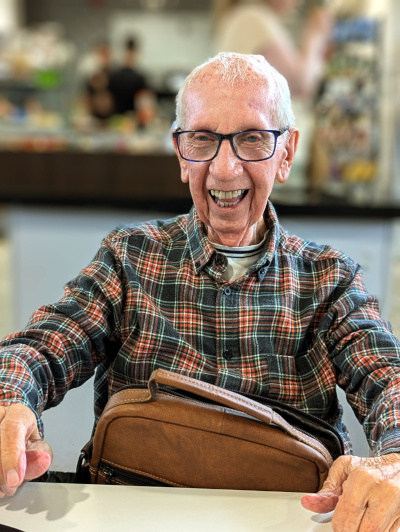
Brian was a small man, exceedingly polite and gracious. He was trim and neat in his dress, and friendly with everyone he encountered. He was a social creature.
We were four friends who met every Friday night for drinks and conversation in the foyer of the Wales Millennium Centre. During the last year, we were only three, as Brian found the effort of driving there at night too difficult. Still, he persisted in joining us and others at Coffee Club every Tuesday afternoon. Then he could get a lift with one of the others. We moved to a table closer to the door by which he would enter, so he could have a shorter distance to walk. His cancer was exhausting him. He began arriving with a cane. Then a walker. Then he was being pushed in a transit chair, which he didn’t like. Although it would take longer to traverse the short distance from the car to our table, he insisted on accomplishing it under his own power with the walker. He continued in this manner up until the time he stopped coming.
Above all else, relationships were important to him, and it was only in the last month of his life that he failed to appear. At that point, we went visiting him individually at his flat. For the last two weeks, we have been visiting him in hospice.
I was there when the hospice staff interviewed him, asking him about his religion. He said he wasn’t religious and was unaffiliated to any religion. I realized the interviewer was misunderstanding Brian, who was unintentionally providing misinformation. I volunteered that while not religious or affiliated, he nevertheless believed there was a god and an afterlife. Brian and I have talked about it.
He also told the interviewer, when asked, that he was absolutely unwilling to go into the hospital. I knew what he meant because we’ve talked about this, too. He didn’t want to be kept alive by extreme or artificial means. He didn’t want to be resuscitated or intubated. But he didn’t mean he wouldn’t go to the hospital for treatment of ailments from which he could recover, such as treatment for edema.
This was a brave man. He didn’t fear death, but death annoyed him because he wasn’t finished enjoying life. Which reminds me of a story he told both to me and to Steve. At fourteen, finding he had enough money saved, he took the ferry and train to Belgium because he wanted to see it. Called his parents to let them know he was alright and was making his way home. Meanwhile, his parents had called the police. But there is an unaccountable element to his story. He said he went to see the Atomium in Brussels. It was finished being built for the Belgium Expo 1958 when Brian would have been twenty. Did he conflate two important moments in his life. Now it is too late to address the question to him.
His father, the owner of a women’s clothing store, arranged for him to have his first job in a local bank. There he acquired his accounting skills, but the drudgery of the bank did not suit him. He took his newly acquired skill to sea, becoming a purser in the merchant marines. In time he went from cargo ships to passenger-carrying ocean liners. He was very keen to correct me that they were not cruise ships.
When he retired from his career at sea, he took on the temporary job of a corporate chauffeur. Although temporary, he enjoyed it so thoroughly, he stayed with it longer than expected. Driving was a pleasure. So was meeting interesting people. There were celebrities, but he never volunteered those stories. They popped out by accident, if you happened to ask the right questions.
He didn’t stay in the role of corporate chauffeur. He was offered a job to scout for and to manage office space, and this, in turn, led to a managerial position in the construction of the Chunnel (the Channel Tunnel).
This is what has to be said about Brian. He had a very happy childhood. He had a very happy life doing what he wanted to do after leaving the bank. He admitted his luck, loving his careers, surrounding himself with good friends, and adoring his family, and loved travelling the world.
At his eightieth birthday party, which he threw at Côte Brasserie in the Bay, he declared his plans to live to a hundred. We expected he could. He still wanted to visit China, India, and Japan. He had been to Hong Kong. His dream was to spend the rest of his life living aboard MS The World, a residential cruise ship, a floating condominium.
I try to make every organ concert at Saint John the Baptist Church. I don’t need to see the back of the organist at the console, but prefer to sit in the second pew facing the towering bass pipes and having their sounds immerse me. For a long time, Brian joined me, the only one to share that pew with me. His arrival often surprised me as I thought the weakness of his state would prevent it. As he was unable to attend the last few concerts, I have sat alone in our pew wondering if he would surprise me again. I will be lonelier at the next concert knowing he cannot appear.
Brian and I used to meet for dinner on Thursdays at the Real Italian Pizza Company, which is next to the bell tower of Saint John the Baptist Church. As we dined, we were serenaded by the campanologists rehearsing on the church’s fine peel of ten bells. When I eat there again, it will be in the presence of Brian’s ghost.
For years, I told everyone I didn’t want birthday cards, a foul practice at my age, being reminded of growing irreparably decrepit. And yet Brian would not obey my wishes. Not only did he find some banal birthday card, more comical than sentimental, but he would place it himself in my mailbox to avoid the postage. When I complained, he said, “The birthday card is not for your sake; it’s for me to have the pleasure of celebrating you.” I’ve grown more tolerant of birthday cards.
The Coffee Club was meeting again in the foyer of the Wales Millennium Centre. I had notified them all this morning by text that our friend had died. They had shared the news with the members of the WMC staff and several, who knew Brian best, came over individually to convey their condolences. Brian had made friends of them. His absence was conspicuous.

Mr Bentzman will continue to report here regularly about
the events and concerns of his life. If you've any
comments or suggestions, he would be pleased to hear from you.
You can find his
several books at www.Bentzman.com.
Enshrined
Inside Me, his second collection of
essays, is now available to purchase.