A Precocious
Baby Philosophizes
I. Professor Johnson’s Emotional Rollercoaster
You should’ve seen my eyes. Oh, how they beamed!
A prize in Sweden felt within my reach
because I’d done what others only dreamed:
I’d made a tool that turned to natural speech
the coos and cries on every infant’s lips.
Yet, soon the thoughts that further tests revealed
destroyed my dreams of science fellowships.
I want recordings buried, burned, or sealed.
II. An Uncovered Recording of Subject S (“Baby
Schopenhauer”)
We learn to hate and learn to disagree
from speaking age to passing from this world,
but early on, we see what others see
when forced to leave the womb we’d snugly curled
ourselves in, having not a single care
or need to take a stab at making sense
of chilly, loud, and blinding spaces where
the gaps between the objects are immense.
The time before the garden gates were crossed
was short on hints that might’ve helped predict
the speed with which a paradise is lost
and terrors that the future would inflict:
the urge to shout ‘til sweaty, hoarse, and red,
to act a tyrant full of rage and greed
in lieu of always staying warm and fed
without demanding servants meet a need.
Around the age of four or maybe five,
our memory of those days is all erased
since few would likely choose to stay alive
unless forgetting what this life replaced.
When younger, babies had no way to know
the means to bring about a wanted death,
or else they might’ve tried to stop the flow
of air inhaled as life-sustaining breath.
Adults are often full of boundless mirth
and tend to laugh and smile when kids are born,
but babies always wail on greeting Earth
because they only find a cause to mourn.
The parents wink at babbled sounds they’ve heard
and dry the tears their babies’ eyes have cried,
but “goo” and “ga”, if rendered as a word,
are infants’ pleas for aided suicide.
Paul Burgess
If you have any thoughts about this poem, Paul
Burgess would like to hear them.
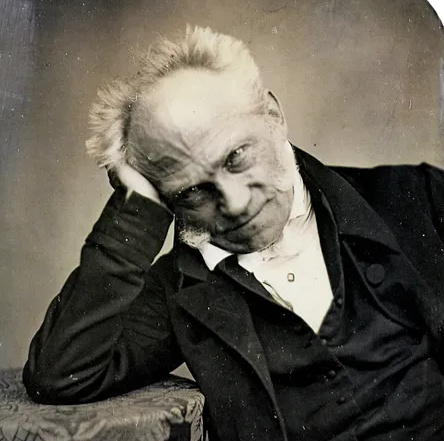
Arthur
Schopenhauer