A discursive (that is to say long and rambling) essay remembering the author's primitive attempts to program his computer to write poems, and asking to what extent AI can do better. Probably of interest to nerds only.
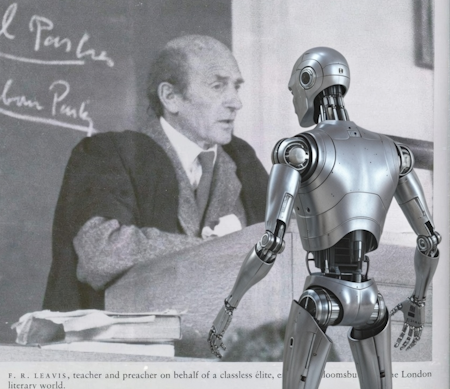
Grok imagines Dr Leavis being confronted by a robot.
Sometime back in the seventies the philosopher Dorothy Emmett, (who had been my tutor briefly at Manchester) met the great, and often abrasive, literary critic F.R. Leavis at a party. Making conversation, she asked: ‘Did you know that there is now a computer that can write a poem?’ I’m sure she relayed the news enthusiastically. (She could be very enthusiastic, and was even enthusiastic about one of my essays once.)
Leavis was unimpressed, and returned to this conversation in several of his late writings, declaring that anyone who thought a computer could write a poem could have no idea what a poem is. He valued poems that were the deepest and subtlest expression of human thought and feelings; to suggest that a mere machine could create one was a kind of blasphemy.
There is much to be said for
Leavis’s attitude, but there is definitely another side
to the question. Yes, yes, a poem can be ‘the precious
lifeblood of a master spirit, embalmed and treasured up
on purpose to a life beyond life’, but a poem is also an
arrangement of symbols. Computers were invented to
organise and arrange symbols – so why can’t they write a
poem?
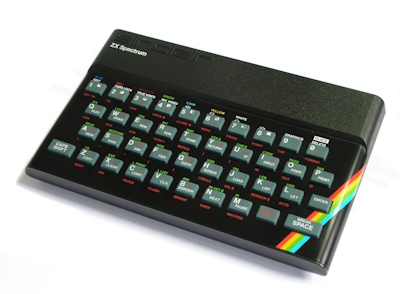
It’s a question that strongly intrigued me at one period in my life. When I first owned a computer (a Sinclair Spectrum, back in 1982) I learned the basics of programming, and became interested in the way that a simple program, given a vocabulary of words whose grammatical function was defined, could generate English sentences. I enjoyed the nonsense sentences it produced: ‘The greengrocer strangled the cold fish slowly.’; ‘A rancid aunt likes bananas.’ I would set the machine to print out random sentences. Then it printed one that brought me up short:
‘My knife imagined a death.’
This sentence had a resonance
missing from the other, sillier products of the program.
It almost had a poetic feel to it, you might say.
Which set me thinking about why
it sounded poetic to me. Was it the dramatic
subject-matter? Was it the personification of the knife?
Was it the apparent compression of so large an idea into
five words? Or was it just that it seemed to fit into a
classification of sentences that might sound poets?
If it was poetic, who was the poet?
Was it the computer? But that picked ‘knife’ and ‘death’
from a list of random nouns, with no notion of what they
meant. The computer did not even know what a noun was.
It just selected items from the array it was instructed
to pick from.
Was it the programmer? But ‘knife’ and ‘death’ were
there with nouns like greengrocer’, ‘aunt’ and ‘fish’.
And ‘imagined’ was just one of a jumble of transitive
verbs. The programmer was, if you like, the creator of a
mini-language that included the possibility of the
sentence, but he had not written this sentence.
Was it the reader? Is poetry in the eye (or ear) of the
reader? One thinks of poets who divide opinion. T.S.
Eliot’s work is now very highly valued, but in the 1920s
there were intelligent readers who thought it was not
poetry at all. William Blake got very small attention in
his lifetime, and only after his death did some critics
begin to teach the world that writings previously
dismissed contained great poetry. John Donne was valued
in his lifetime, neglected as ’not proper poetry’ for
two hundred years, and then rediscovered. Those
who did not see the poetry in these authors were not
necessarily stupid. They had other criteria for poetry
that these did not meet.
Now remember – this was all ‘Top down’ programming. The
computer blindly chose words from lists I offered,
arbitrarily as anything.
I moved on from creating sentences to creating verses. I
was inspired by the French Oulipo writers – especially
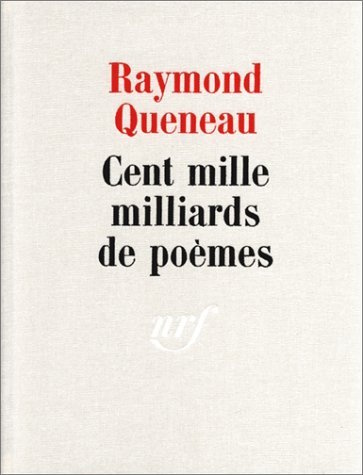
Raymond Queneau and his Cent
Mille Milliards de Poemes, which shuffled
alternative lines of a sonnet to produce an almost
interminable collection of possible poems.
My homage to this appeared in
Snakeskin – The Collaborative
Sonnets. In these poems lines by Linda
Crespi and William Shakespeare are randomly interleaved
to produce alternative versions of the poem. (This was
written in JavaScript, a language which has evolved
since then. Like a number of my other JavaScript works,
the sonnets still work on some browsers, but not on
many. Things change.)
Those sonnets came later; my key experiments were almost
all in the pre-Snakeskin days. When I had moved on from
the Sinclair Spectrum to a PC I used Microsoft
QuickBasic, a very easy-to-use and adaptable language. I
gather that it is still kept alive by enthusiasts.
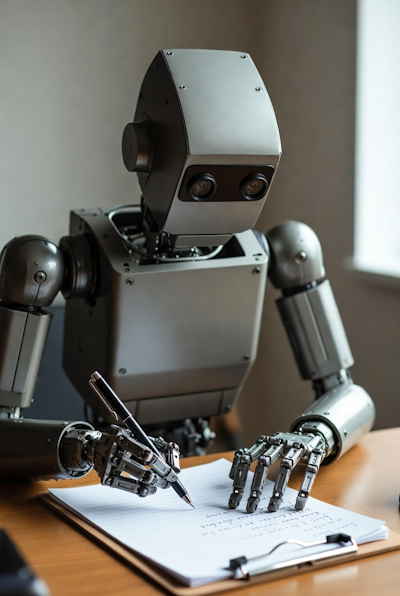
Grok imagines a
robot poet
What I was wondering was: Could I go on from generating
sentences to generating poems? After a fair bit of work,
I got my computer turning a list of words into iambic
pentameters – quite tricky. Syllables had to be labelled
strong or weak. The first results were very clunky
indeed, until instead of a binary strong/weak system, I
used Trager-Smith notation, which gives four possible
values for the strength of a syllable’s emphasis. If the
second syllable of a foot has a higher number than the
first, then it’s passed as iambic. Single iambic lines
were achieved eventually. Putting these together in a
poem produced end-stopped horrors, however. Making
a programme that could manage enjambment was trickier
still, but I managed it.
As poetry the verse these programs produced was
negligible. I fashioned simple narratives that could be
told in millions of ways. I made a simple program that
told the story of how Cleopatra walked into a
restaurant, tasted the food and walked out. The
restaurants she visited were many and various, as were
her possible reactions. It was silly, but with it I
learned to craft convincing pentameters.
Alas, over thirty-odd years and computer crashes and
house-moves, I no longer have the QuickBasic programs I
worked so patiently at. Maybe some are on a floppy disk
I can’t now play. Just possibly some are recorded
on a CD. Some day perhaps I'll hunt for them, but almost
the only remnant I can lay my hands on is a collection
of poems written by my ‘GothicVerse’ program, a more
sophisticated experiment in writing an iambic verse
narrative. A few years after I’d written
the program, an e-pamphlet of thirty-four
typical pieces of output appeared in
Snakeskin 147 in 2008, It is credited to my alter ego,
Linda Crespi.
These poems tell a story that is constructed by the
permutation of narremes (little narrative fragments, as
explained in S/Z by Roland Barthes. The sequences of
narremes describe the progress of a group of
travellers, the worsening of the weather, the illness of
Sir John, and things they see along the way. The various
sequences are all in narrative order, but can be
interleaved in any way. Each narreme can be constructed
in a variety of ways from a bank of suitable phrases.The
tone of the poem I based on Robert Browning’s paranoid
mediaeval narrative Child Roland to the Dark Tower Came.
The phrases the program randomly selected from
were all grim. But then, writing grim poems is always
easier than writing happy ones.)
Here’s a typical example:
| Our silver-haired companion groaned.
We all Observed a glowing crystal. Air was foul, And therefore dirty thoughts disturbed our minds. The afternoon was cold as hate. Our path Led nowhere. We had stumbled on the way. Our gallant band - I'm joking - had to pause Before a corpse, whose boots we stole. Sir John Was dead, we all decided. Finally We stopped at something brutish. Our crusade Had reached its pointless end. The godless sky Grew dark, and bitter snow fell silently. |
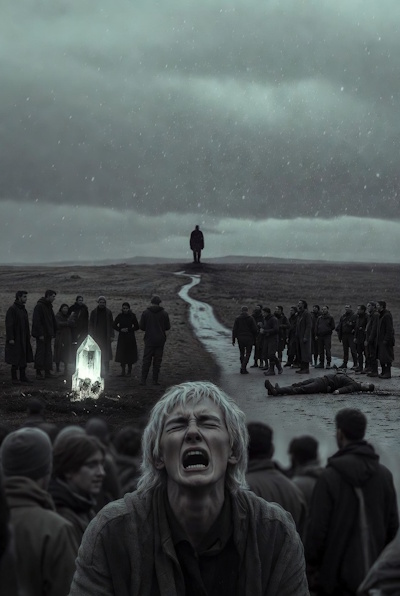
If you want to read
thirty-three more examples of the program's versifying,
a pamphletful can be found at: https://www.snakeskinpoetry.co.uk/147gothp.pdf
So is this computer-fashioned thing a poem? If I took it along to a poetry workshop, concealing its origins, I’d expect it to be challenged in all sorts of ways, about its quality, its attitude and its limitations, but I don’t think it would be automatically rejected as machine-made. And if it’s a poem, who is the poet?
- The computer? As with the knife sentence, no. The computer makes random placements of phrases, as programmed. There is no intention at work there.
- The programmer? Maybe. The programmer chose the phrases, non-randomly, to set a certain mood and tone. The programmer certainly set a limit on what the poem could say. On the other hand, the programmer had no idea that this precise poem would be the output. Perhaps we should say that the programmer created a genre, of which this is an example.
- The reader: Yes, I think so. The reader brings expectations of what a poem is – lines that don’t reach the right-hand margin; iambic lines that make it sound like a poem; there is some alliteration; it has a consistency of tone; it has dramatic content. These factors nudge the reader into reading it as a poem (whether or not he or she thinks it is a good one).
That’s almost the limit of
where I got to with programming poetry. I had vague
plans for a much bigger program that would somehow adapt
Vladimir Propp’s ideas about the morphology of the
folk-tale to generate stories that could then be
expressed in verse. I think I made a small start on
it, but other projects got in the way. I also
considered the problem of programming rhyme; not
impossible, but one would need to make a large
word-hoard available.
Just as my sentence programs
had got the grammar right according to the rules, but
with random disregard of what the words might actually
mean, so in the poetry programs I had dealt moderately
well with the syntax of poetry, but not at all with the
semantics. In other words, the program arranged the
phrases nicely, but with no regard to what they meant.
It was top-down writing, with no notion connection of a
reality rooted in experience.
A couple of years back, when I first heard that ChatGPT
was offering to compose poems I had to try it out. Our
local Zoom group had been talking about trigger
warnings, so I asked for a poem on the subject; here’s
the result:
| A word that stings, a memory that
burns A feeling that creeps, a fear that returns A sight that haunts, a sound that jars A touch that triggers, old battle scars The heart races, the breaths shorten The mind replays, the past threatens to darken The body trembles, the eyes tear The soul whispers, a plea for a safe sphere. The trigger pulled, the damage done The aftermath felt, by everyone May we be gentle, may we be kind For we never know, what triggers we might find. |
The verse is clunky, and the idea of what a poem is has not got far past the Hallmark cards stage of sophistication. What it does have is a good vocabulary; it has looked up th idea of triggering, and has produced an impressive list of synonymous phrases, arranged in more-or-less iambic tetrameters, and rhyming in couplets. The thing disintegrates rather in the third stanza. The metaphorical trigger now seems to be on an actual gum, and the punctuation gives one no confidence that the poem knows what it’s on about (why those commas after ‘felt’ and ‘know’?)
One gets the idea of the
program fishing for things it could say, and striving to
say them in a way that could be taken for a poem.
ChatGPT, Grok and others use Large Language Models. They
have been given access to vast amounts of writing, from
which they get a vocabulary, and also patterns of
writing and expression. They find a consensus that has
been expressed on a subject, and treat it as a
collection of facts. But it's not facts; it's documents.
It’s all words. They have no experience of life. The
poet Lucretius saw the problem with this two thousand
years ago; what we know for certain comes from what we
actually see, hear and feel. The rest is hearsay –
sometimes based on sound authority, sometimes not, but
we can’t be sure.
| Unless we place Our firm faith in sensation, we shall have nothing to base Conclusions on concerning what lies hidden from our view, Nor could our reasoning confirm that anything is true. Lucretius
-translated by A.E. Stallings
|
Large language Model programs
use reasoning to try to work out what is true. When we
ask them question, they often come up with accurate
answers. Sometimes, though, they can seem like the
student who has done all the reading, but has missed the
point. They scour large numbers of documents to come up
with an answer, but know nothing outside those
documents. They therefore reflect the attitudes of those
documents. They can’t venture outside the world created
by the language of the documents. Except that on
occasion, it seems, they can be tempted; lawyers ask AI
to help them make a case, and sometimes, too helpful,
the program creates references to case law that would be
very helpful if it were not fictitious. Seeing that the
genre of legal argument needs to have cases as proof, it
invents, or hallucinates them. In this kind of instance,
AI is like the rather too helpful person from whom you
ask directions. He doesn’t want do seem ignorant or
unhelpful, so he says something that might be true. ‘Go
up to the church and turn left,’ he says, in a helpful
voice. So off you go in entirely the wrong direction.
But hallucinations and false trails are a problem with
factual AI. Poetry has different problems. Keats, like
Lucretius, felt that: ‘..axioms in philosophy are not
axioms until they are proved upon our pulses.’
Experience is the guide to truth, in poetry or
philosophy. AI has no experience – it can only fake it.
For an example of faking, let’s see what Grok makes of the ‘Write a poem about trigger warnings’ prompt, two years after ChatGPT came up with the Hallmark-style rhyming:
| Trigger
Warnings Before the poem begins a small white gate is placed across the path of words Here be dragons says the sign here be memories wearing someone else’s skin Proceed with care the management is not responsible for what your nervous system decides to recognize We have catalogued the usual suspects: blood (graphic) child (harmed) knife (held to throat) father (returning home drunk) mirror (telling the truth) Yet no warning exists for the smell of rain on warm asphalt |
This is a much more
sophisticated poem. It is in the chopped-up-prose style
of free verse that is the norm in Poetry Review
and such places. It has significant-sounding phrases
like ‘memories wearing someone else’s skin’. (I’m not
quite sure what that means, but I can imagine things
that it might mean, and they are more or less relevant.)
It has a rather drab catalogue of things that might be
triggers, but they climax with a good one, the mirror,
which does suggest a universal human experience. Then
the last line gives us a most effective sensual reminder
of petrichor, that special smell of rain on hot ground.
This AI model has grasped that a personal sensation is a
good way to end a poem. An internet search tells me that
there are plenty of contemporary poems that refer to
this. Grok has selected well, and has used something
that others have told him humans respond to strongly.
But he is proving it on what he’s been told about other
people’s pulses, not his own. This is a reasonably
thought-out poem, but thought is divorced from
feeling. If it reads like a poem - well, that's in
the eye of the reader again. It reads just like a huge
number of other inoffensive twenty-first century poems.
It's very easy to accept.
But this poem strives for the impression of being
experience-driven (bottom-up), while in fact is a
pastiche, therefore top-down. Which must be the fate of
all computer-made poetry. Its fate is to be an
imitation. (Yet isn't this also true of all too many
human-made poems? As an editor I frequently receive
submissions from people who doubtless think of
themselves as utterly original. Often it's all to easy
to see who they are (perhaps inadvertently) copying.
To return to F R Leavis, that challenging man: he had a normative idea of poetry – what poetry ought to be. Not much came up to his standards. He notoriously dismissed much of modern poetry, and large swathes of the traditional canon, for not coming up to the mark. He praised poets like Keats and Blake whose thought was inextricable from feeling, and for whom poetic form was not an optional extra, but was the only way in which such a union could be expressed. He was critical of poets who allowed their writing to become mechanical, divorced from their keenest intelligence and feelings. He felt that Milton had been a bad influence of poets for two centuries because he often used his immensely effective verse as a way of conveying existing ideas, rather than deeply engaging with them. ‘‘A good deal of Paradise Lost strikes me as mechanical as bricklaying.’ Perhaps one or two poets in an age come right up to his standards, and he could always change his mind and deem them insufficient, as he finally seems to have done with Eliot.
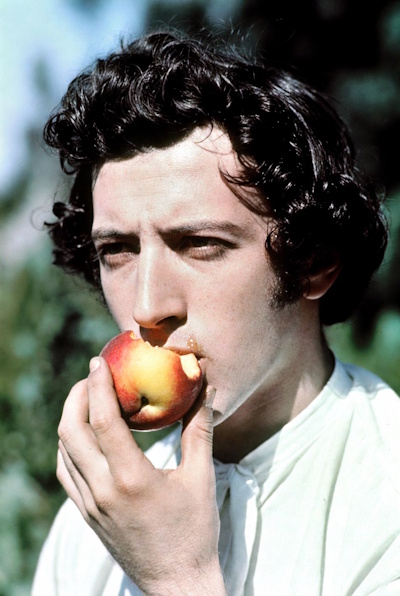
Grok pictures (rather
romantically) John Keats uniting thought and sensation
when he bites into a peach.
My QuickBasic programs were deliberately mechanical; they wanted to see how far mechanical poetising could take one. Today’s AI blurs the picture. It gives the illusion of being bottom-up, arising from experience. But it isn’t, and it can’t be. It is made of text, made of other people’s ideas. It is faking. As a writer of light verse, I often write parodies, pastiches and homages that are to some degree imitations. Is machine poetry on a different level from that. And does that matter?
I
would argue that the big task of literary criticism in
the coming years will be to discriminate between the
fake and the real. Or, putting it another way, to
redefine what human writing is. A hundred and fifty
years ago the invention of photography posed a
challenge to artists and critics. Much of painting
since the Renaissance had been devoted to the precise
rendition of detail. Now photography could do that
better. The art history of the past century and a half
has been the history of artists responding to this
challenge in different ways. There is an intellectual
and artistic battle, and it's not over yet.
I’m not discouraged. I’m sure that AI will be useful,
and may even drive out the human producers in some
genres – advertising slogans, the more formulaic kind
of romantic novel or action thriller, or pornography,
or grievance poetry. Otherwise I think we’ll all get
better at telling what is AI and what isn’t. Already
we’ve reached the stage with Grok’s amazing artworks
where we will say of them: ‘Oh, that’s just AI.’ We
can tell the difference. Now I greatly enjoy playing
with Grok, as you can probably tell from the
illustrations to this issue, but I have come to see
its limitations. It works well in a limited range of
styles. It is good at photo-realism and anime-style,
and a style similar to magazine illustration. Not so
good at Impressionism. It will doubtless develop a
wider range of styles, but they will all be imitations
of human styles. Today AI designs seem new and
refreshing, but that is because they put an old
style (generally photographic realism ) to new
purposes, introducing fantasy of one kind or
another that will be portrayed literally.
It's fun - but I think will soon begin to look very
old-fashioned. To develop a radically new artistic
style of its own would be beyond it, because a
radically new style would have to come from a new way
of perceiving and feeling about the subject-matter and
the medium. It would have to come from contact with
something real.
Which
is why I'm very interested in Robin Helweg-Larsen's
experiment of offering AI his own poems to feed on.
The seed of his own poetry has been enough to raise
the game of the AI program considerably. And a game it
is - which we'll be playing for the next century,
whether we like it or not.

George Simmers imagined as a cyborg made mostly of glass.
If you've actually reached he end of this over-long essay, and have any thoughts about it, George Simmers would be pleased to hear them.