 |
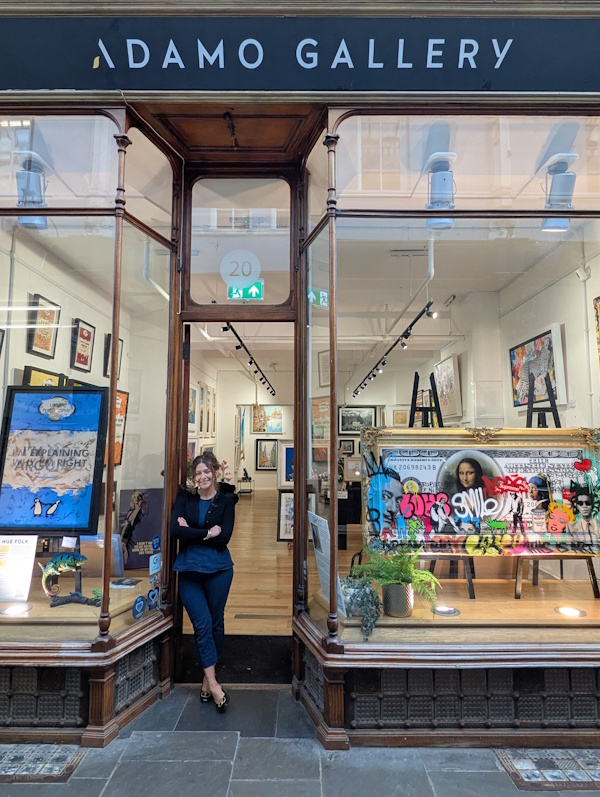
Where I live, Victorian arcades tunnel through the building, lined with shops. The storefronts have large glass panes mounted in beautiful wood mullions. Every day I make my way, with the letters I wrote the night before, through the Morgan Arcade to reach the Post Office on Saint Mary Street.
The route takes me past the Adamo Gallery. If I happen to see Sophie, the gallery’s manager, sitting behind her desk being not too busy or not engaged with a potential customer, I will step in to be sociable. Sometimes it is her assistant, Olivia. They are usually busy and don’t need me to break up the monotony, in which case I will just wave as I trudge past, if they happen to see me. At other times, I go in to see what is exhibited.
On the walls of the Adamo Gallery generally hang large works of bright color and fun. The works exhibited change nearly constantly. They fascinate and I am happy to report they attract buyers. Sophie and Olivia are always kind and attentive, even though I am never buying. My tastes are different, not fashionable or at all contemporary. My tastes remain stuck in 19th century aesthetics. Still, it pleases me to see the business thrive.
It turns out, I am not entirely immune to the works on display. As I happened to walk by the gallery on one of the days they don’t bother opening, I saw a sculpture in the window. It was a sea turtle swimming atop a stand suggesting water, a little more than a foot high. It resembled a sea turtle real enough, but it appeared made from pieces, as if it had been broken and stuck back together, but then there were gaps where pieces were missing. It appealed to me and it was affordable.
Affordable. The price was visible. The reasonable price could only mean it was not one of a kind, but cast. The question then was what was the material and how many were cast. Since the shop was closed that day, I was determined to come back the next.
The next day I learned that the sculpture, Sea Turtle, was by Matt Buckley of Shropshire. The original was rendered in clay. Then a mold was made of the original and a ceramic polystone poured into the mold. Polystone is a mix of resin and stone, and in the case of Matt Buckley the stone is powdered marble. The result is an impressive tactile feel of marble and some heft, but not as much weight as had it been stone or bronze. The piece is then hand-painted in Buckley’s studio. The edition was open-ended, but there had been a colorful limited edition that didn’t interest me. I wanted the one in the window. I came in the very next day to buy it. It had been sold.
That was in August of 2025. Sophie was convinced she could get me another. She offered to order it even though I would not commit to buying it. I needed to be sure of the color it was painted. At my next visit, she told me she had ordered it, but that I was not obliged to buy it.
Months went by and in late autumn, the Sea Turtle had arrived, but it had been damaged in transit. A fin had broken off. It could not be repaired. Sophie never even showed it to me.
A couple more months passed and Sophie told me there was a problem at the studio. They were waiting for the delivery of the paint they required for the Sea Turtle.
Winter went by and on the day of the vernal equinox, Sophie announced the Sea Turtle had arrived, but it was still in the box. She wanted to include it in the exhibition opening on Saturday, and why had I not RSVP’d to the email inviting me. I promised I would be there.
The CHROMA exhibition that Saturday was to introduce the works of Joe Galindo: “Known for his vibrant abstract depictions of wildlife, he builds his paintings through an experimental process, often using unconventional tools like spoons, nails and rubber to create layers of movement, texture and colour.” The small gallery was satisfyingly crowded. I squeezed past the clientele with a glass of Prosecco to study every work on display, then settled on a stool at the bar. The soon-to-be-mine Sea Turtle was exhibited on the bar. I admired it, making Olivia aware that the final decision was to buy it. It stayed there until the next day, Sunday, when I returned to collect it.
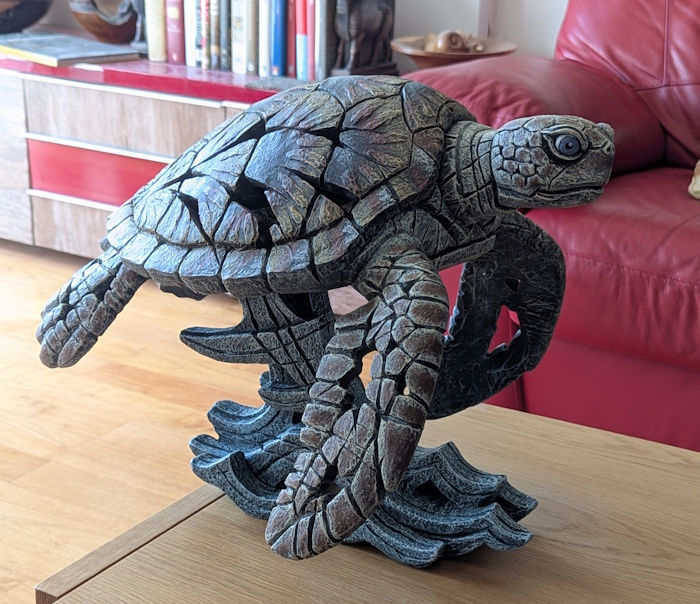
The Sea Turtle presently stands on my coffee table, but I might move it to a low chest, where it will share space with books too tall to go on shelves. The books are held upright between a pair of Assyrian human-headed winged bull bookends, lamassu, purchased from the British Museum. They are also made of resin.
Will I always keep the Sea Turtle? Perhaps not. Perhaps it is only a placeholder until I can afford something more precious and unique, and maybe from the 19th century. However, we sin against the culture if we don’t strive to patronize living artists.

Mr Bentzman will continue to report here regularly about
the events and concerns of his life. If you've any
comments or suggestions, he would be pleased to hear from you.
You can find his
several books at www.Bentzman.com.
Enshrined
Inside Me, his second collection of
essays, is now available to purchase.