The Bedspread
Catullus 64, lines 43 - 153.
This is an extract from an ongoing translation of
Catullus's Carmen LXIV, an epyllion (compressed epic) based on
the marriage of Peleus and Thetis.
['The Trojan war began at the wedding of Peleus and Thetis' -
Mary Beard.]
Locals have come to the palace to celebrate the marriage of
Peleus and Thetis.
They marvel at the splendour of the palace, and especially at
the design of the rich
tapestried quilt on the bed
In each rich
recess of this palace, see
Gold glisten, silver beam; pale ivory
Glows upon thrones; the whole house takes such pleasure
In the rich splendour of its royal treasure.
And at the house’s centre is the bed,
Fashioned from polished Indian tusks and spread
With a coverlet, thick-woven; every eye
Must thrill to see so deep a purple dye.
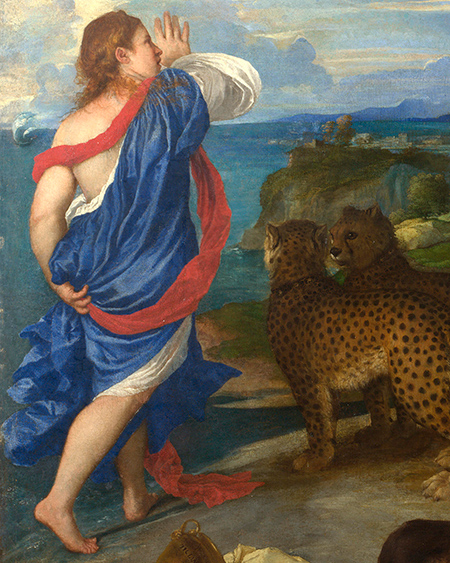
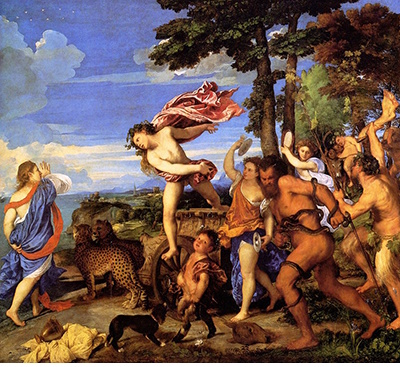
The marvellous quilt represents the story of Ariadne, deserted
by Theseus on the island of Naxos.
Pictured here is a detail from Titian's version of the
story.
On this great quilt, a rich embroidery
In precious stitches tells a history:
Of the beach at Naxos, where the hopeless sound
Of tumbling waves repeats, while northward-bound
The ship of Theseus speeds far away,
While Ariadne stares beyond the bay.
Uncomprehending how he could depart;
She feels love like a beast bite at her heart.
And savage her. From dark deluding sleep
She’d just awoken fresh; now at the deep
Sea’s weeded edge she, unbelieving,
Stares at the ship of Theseus as it’s cleaving
The waves pell-mell, in the face of wind and weather,
Love-promises forgotten altogether.
Still now as a Bacchante carved in stone
On the sparse beach the princess stands alone,
Till in her heart despair begins to flare.
She shakes away the bonnet from her hair,
Shrugs off the light blouse, and the scarves that bind
Her milky breasts – left for the waves to find
And steal away. She has no other thought
Except you, Theseus, for her heart’s tight-caught;
In Venus'
trap she’s merely prey, love-riven,
A woman whom vicissitudes have driven
To madness, victim of deceit and scorn.
She’s felt the stabbing of love’s jaggedest thorn,
This woman whose whole destiny was marked
On that day when the hero disembarked
From his curved ship to face the Minoan King.
That day began all of her suffering.
Back-story: foul plague raged, which indicated
Androgeous’ murder must be expiated
By the sacrificial tax each year of ten
Of the finest of Athenian young men,
And ten young women, all to be the prey
Of the brutish Minotaur. Theseus, in dismay
At his city’s loss, at such forced diminution
Of Athens’ strength, made a free resolution
To ship himself alone to Crete, instead
Of that sad shipment of the good-as-dead.
The favouring winds conveyed his strong ship straight
To rocky Knossos, where, in splendid state
King Minos rules.
As he arrived, the eyes
Of a royal virgin stared, with silent sighs
Of yearning; this was Ariadne, she
Whom the queen had raised in perfumed luxury,
Secluded; myrtles by the riverside
Are not more sweet, nor flowers that open wide
To greet the spring; and as she gazed, desire
And longing worked within her; she felt fire
Speed through her body, burn into her marrow.
Oh Cupid, with your pitiless childish arrow
You spread random madness, misery and joy,
And Venus, mother of that sacred boy,
You, Queen of Golgos and Idalium
What is this flood of love? What waves have come
To sweep her up, incapable of rest,
By her brave golden-headed guest posessed?
Her heart is clenched by dreads that can’t be told;
Her lovely skin grows sallower than gold,
As she’s imagining his fate tonight
Meeting a monstrous brute in a savage fight
That will either end, full-stop, brave Theseus’ story,
Or else will win him everlasting glory.
Ariadne longs to please the gods, and dares
To hope that they might listen to the prayers
She hardly voices -
But, like the gale that lashes
On Taurus a massive oak so that it crashes
Uprooted, boughs still waving, or that smashes
A great pine till it falls, crushing all below.
So Theseus with one decisive blow.
Sends the beast sprawling, helpless, jabbing at air
With ineffective horns in death’s despair.
A hero and knowing it, Theseus heads back, led
Through confusion back to safety by the thread,
Without which, in this maze of mazes, he
Would be lost in the riddling complexity
Of the labyrinth’s indecipherability
But why digress? And do I need recall
That Ariadne had turned her back on all
Her home and kindred, on her father’s face,
Her sister’s love, her mother’s kind embrace.
These lives are now ruined by Ariadne’s flight.
Her Theseus’ love had been her one delight.
His ship brought her to Naxos’ foamy shore,
But his forgetful heart beats here no more.
He’d left while she’d slept here, left her to languish,
She woke, and saw the truth and in pure anguish,
Screamed all her being’s utter agony.
She climbed the steep tall cliffs so she could see
The empty ocean’s vast immensity,
She hopeless rushed forward, lifting high her skirt
Into the breaking waves, and all her hurt,
And all her wretchedness and devastation
Are voiced in this, her sobbing lamentation.
So is this it? Have I been dragged away
From the home I know, discarded, left to stay
On this dismal beach alone? Oh Theseus, how
Could you do that? Never mind your perjured vow -
Never mind the gods offended - could you find
Not one kind thought within your ruthless mind?
No decency either? In your pitiless
Bowels no trace of mercy? You said you’d bless
Me with bride-bed joys, with wedded happiness.
Such light words could be blown away by just
The tiniest gust of air. Oh women, never trust
The words a man speaks to you; don’t think his vows
Are given in good faith. Desire will rouse
Men to say anything; when lust’s inflamed
They’ll lie and lie and lie, quite unashamed.
Who saved you from extinction, Theseus? I
Preferred to see my own sad brother die
Than have you fail in that most crucial hour.
In return you left me here where beasts devour
All comers. Soon my body will be found
Half-chewed and naked, unblessed, above the ground.
To be continued...
Gaius Valerius Catullus
translated by
George Simmers
If you have any thoughts about this translation , George Simmers
would like to hear them.
George Simmers's translations of some of Catullus's other
poems have been published in a booklet. For details, click here.