Adventures
of Diogenes
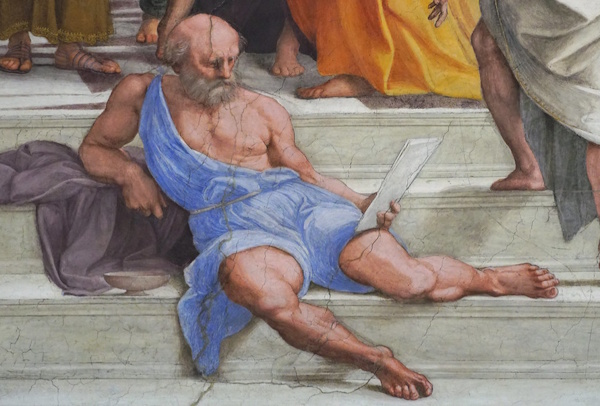
This is how Raphael imagined Diogenes
Part 6
In which Diogenes encounters
the principal of a company
Diogenes saw them entering,
Saw the importance of the swing
With which they passed the shop’s glass door,
The man behind, the lackey fore.
This was no as-the-mill-runs man
Whose entrance pulsed with such elan.
The patrons stared who were about.
He was a boss, there was no doubt.
His lackey paid the coffee bill
While he surveyed the room at will.
“I almost have it,” hummed the boss
Moving his head with self-sure toss.
“I’ve almost done what I must do
Before the working day is through.”
The Cynic, wondering at the speech,
Was eager for the boss to teach
What thing he had so near in reach.
“Hey boss!” began Diogenes.
“It would my humble person please
To know this thing you’ve almost got.”
The boss looked pleased that he was sought
To discourse on his working day.
He said: “My quarry and my prey
Are an emotion to allay.
Each day a feeling I devise:
This is my work and enterprise.
You see, I am the principal
Beneath whom the employees fall.
They live in expectation of
Th’emotion I emote above.
Whatever feeling that I feel
My workers come on winged heel:
They change agendas, drop all tasks
To answer what my feeling asks.”
Diogenes was, he said, intrigued
Which sort of feelings he relieved.
“Oh, infinite,” the boss replied.
“Ever my heart is newly tried.
One day it’s anger animates,
The next a sullen silence grates,
Or else a bright idea elates.”
The Cynic wondered something more:
Remain at work or seek the door
Once the emotion had been found:
Must he decamp or stay around?
Most often (said the boss) he stayed
To see his feeling was obeyed.
As an executive he must
Essay to execute his trust.
A further ask Diogenes made
Regarding how the Boss conveyed
The daily feeling he conceived,
Whether good-humored or aggrieved.
The boss said, with variety
He let his anxious workers see
The feelings that oppressed his breast
And actions consequently best.
At times, an email like a shot
Unveiled the feeling he had got.
At other times a tetchy word,
But even wordless was he heard:
Th’expression of the face was key
If others were the mood to see.
He often liked to walk the hall
And unsuspecting worker call
To check if all were paying heed
To present mood with needful speed.
At last Diogenes asked if there
Were other tasks the workers bare
Besides attending to each mood
The boss was hired to exude.
“Indeed I hope not!” cried the boss.
“It would be such a wasteful loss.”
Andrew Horne
If you have any thoughts about this poem, Andrew Horne
would like to hear them.